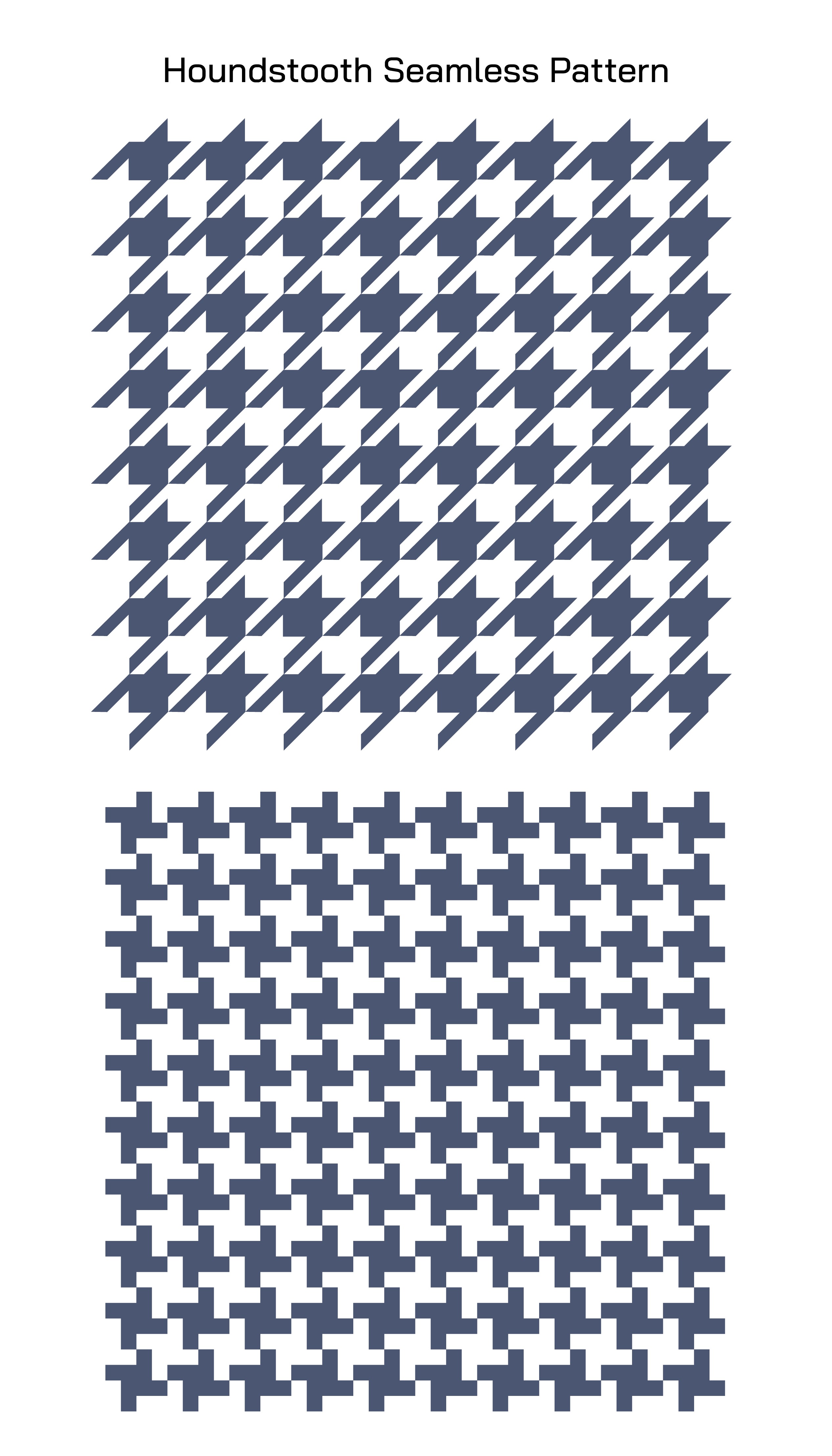
The houndstooth seamless pattern is one of the most recognizable and enduring designs in the world of textiles and visual arts. Known for its bold geometric structure and high-contrast appearance, this pattern has transcended generations, cultures, and industries. Its ability to remain relevant across changing fashion trends and design movements highlights its timeless appeal. The houndstooth pattern is not merely decorative; it represents heritage, sophistication, and visual strength, making it a preferred choice in both traditional and contemporary design applications.
Visually, the houndstooth pattern is defined by a repeating broken check or abstracted tooth-like shape. The design is typically created using contrasting colors, most commonly black and white, which enhances its sharp and striking appearance. When arranged as a seamless pattern, the motif repeats continuously without visible breaks, allowing it to cover large surfaces smoothly. This seamless quality is essential in textile manufacturing, digital design, and surface decoration, where continuity and consistency are crucial.
One of the core reasons for the popularity of the houndstooth seamless pattern lies in its versatility. The pattern can appear bold and dramatic at large scales or subtle and refined when reduced in size. This scalability allows designers to adapt it for a wide range of uses, from statement outerwear to delicate accessories. The geometric structure provides visual order while still maintaining dynamic movement, making it appealing to both minimalist and expressive design styles.
In the fashion industry, houndstooth is widely regarded as a symbol of classic elegance. It has been used extensively in coats, jackets, suits, skirts, scarves, and footwear. The pattern conveys structure and confidence, which is why it is often associated with tailored clothing and formal wear. Designers frequently use seamless houndstooth prints in fabrics to ensure clean cuts and uninterrupted visual flow across garments. Its strong identity allows it to stand alone or pair well with solid colors and simple textures.
Beyond apparel, the houndstooth seamless pattern is highly popular in interior design. It is commonly used in upholstery, cushions, rugs, curtains, and wallpaper. In living spaces, the pattern adds visual interest without overwhelming the environment. Its geometric repetition creates balance and rhythm, making it suitable for both modern and traditional interiors. Designers often choose houndstooth for accent pieces, where it introduces sophistication and contrast into a space.
Graphic design is another area where the houndstooth seamless pattern has gained widespread use. It is frequently employed as a background texture in branding, packaging, editorial layouts, and digital media. The pattern’s clean geometry makes it ideal for high-end branding and luxury aesthetics. When used in seamless form, it allows designers to create consistent visuals across multiple platforms, including websites, print materials, and social media assets.
The popularity of the houndstooth pattern is also deeply rooted in its historical association with craftsmanship and tradition. Originally linked to woven textiles, the pattern reflects precision and attention to detail. Over time, it became associated with refinement and status, reinforcing its presence in premium design categories. This historical depth adds emotional value to the pattern, making it more than just a visual element.
In modern design culture, houndstooth has been reinterpreted in countless ways. Designers experiment with color variations, scale shifts, and digital distortions while maintaining the recognizable core structure. Bright colors, metallic finishes, and unconventional pairings have brought new energy to this classic motif. Despite these innovations, the seamless repetition remains essential, ensuring visual harmony and functional usability across surfaces.
Another reason for the pattern’s enduring popularity is its adaptability across demographics and markets. Houndstooth can appear formal or casual, masculine or feminine, bold or understated, depending on its execution. This flexibility allows brands to target diverse audiences while retaining a strong visual identity. As a result, the pattern is frequently used in both luxury collections and everyday consumer products.
From a psychological perspective, the houndstooth seamless pattern appeals to the human eye because of its balance between order and complexity. The repeated geometric forms create predictability, while the broken shapes introduce movement and interest. This balance keeps the viewer engaged without causing visual fatigue, which is a key factor in its widespread adoption across design disciplines.
In the digital era, seamless patterns have become especially important, and houndstooth fits perfectly into this demand. Whether used in digital wallpapers, mobile applications, online stores, or social media visuals, the seamless nature of the pattern ensures adaptability across screen sizes and resolutions. Designers value houndstooth for its ability to maintain clarity and impact even in digital formats.
The continued popularity of the houndstooth seamless pattern can also be attributed to its strong association with timelessness. Unlike trend-driven patterns that rise and fall quickly, houndstooth consistently returns to prominence. Its reappearance across decades reinforces its status as a design staple rather than a passing trend. This reliability makes it a safe yet stylish choice for designers seeking longevity in their work.
The houndstooth seamless pattern can be explored not only as a visual motif but as a structural language of design that communicates stability, rhythm, and refinement. At its core, the pattern is built on precise repetition and angular geometry, which gives it an architectural quality. Unlike organic or floral patterns that rely on curves and irregularity, houndstooth is defined by sharp edges and controlled symmetry. This makes it especially powerful in conveying clarity, discipline, and confidence across visual surfaces.
A unique aspect of the houndstooth pattern lies in how it interacts with distance and perception. When viewed up close, the individual shapes appear bold, angular, and highly defined. However, when seen from a distance, the same pattern visually blends into a textured field that can resemble a solid tone. This dual visual behavior allows designers to use houndstooth as both a statement element and a subtle background, depending on scale and context. Few patterns possess this ability to transform visually without changing their fundamental structure.
The seamless construction of houndstooth is particularly significant from a technical standpoint. Seamless repetition requires mathematical precision in spacing, alignment, and proportion. Any inconsistency would disrupt the continuity of the pattern and weaken its visual impact. Because of this, houndstooth has long been associated with skilled craftsmanship, whether in traditional weaving or modern digital pattern creation. The seamless format ensures that the pattern can extend infinitely across fabric rolls, walls, screens, or printed surfaces without visible interruption.
Another distinctive quality of the houndstooth seamless pattern is its compatibility with material texture. On smooth surfaces such as silk, glass, or digital screens, the pattern appears crisp and graphic, emphasizing contrast and sharpness. On textured materials like wool, tweed, upholstery fabric, or leather, it gains depth and softness, becoming warmer and more tactile. This adaptability across material types contributes to its widespread use in both fashion and interior design.
Color psychology plays a subtle but important role in how houndstooth is perceived. Traditional black-and-white versions communicate authority, formality, and timeless elegance. When rendered in neutral tones such as beige, gray, or brown, the pattern becomes understated and sophisticated. In bold or unconventional colors, it transforms into a contemporary and expressive visual element. Despite these variations, the pattern remains instantly recognizable, demonstrating the strength of its underlying geometry.
In branding and visual identity design, the houndstooth seamless pattern often functions as a signal of reliability and premium quality. Brands that use it tend to associate themselves with heritage, attention to detail, and lasting value. Because the pattern is not tied to a single era or trend, it avoids visual obsolescence. This makes it particularly effective for long-term branding strategies where consistency and trust are essential.
The pattern also has a unique relationship with movement and flow. Although it is geometrically rigid, the broken-check structure creates a sense of directional motion. The eye naturally follows the repeating angles across the surface, producing visual energy without chaos. This controlled movement is one reason the pattern works so well in garments, where it complements the natural motion of the human body, and in interiors, where it guides visual attention through a space.
From a cultural design perspective, the houndstooth seamless pattern occupies a rare position between tradition and reinvention. It is deeply rooted in history, yet it continually re-emerges in modern contexts without feeling outdated. Designers often use it as a foundation upon which innovation can occur, layering new colors, scales, or digital effects while preserving the core identity of the pattern. This balance between familiarity and novelty keeps it relevant across generations.
In digital design environments, houndstooth has gained renewed importance due to its clarity at different resolutions. The strong contrast and clean edges ensure that the pattern remains legible on both high-resolution displays and smaller screens. When optimized as a seamless digital asset, it can be scaled, tiled, and animated without losing visual integrity. This makes it valuable for user interfaces, digital wallpapers, online branding, and motion graphics.
The psychological comfort associated with houndstooth should not be overlooked. Repetition creates predictability, which the human brain often finds reassuring. At the same time, the broken geometry prevents monotony, keeping the viewer engaged. This balance makes the pattern suitable for environments where prolonged visual exposure occurs, such as living spaces, workplaces, and digital platforms.
Another unique strength of the houndstooth seamless pattern is its gender-neutral appeal. It does not rely on motifs traditionally coded as masculine or feminine, allowing it to move freely across markets and audiences. This universality has contributed to its longevity and global acceptance. It can be formal or casual, bold or restrained, expressive or minimal, all without altering its fundamental structure.
In a broader design philosophy, houndstooth represents the idea that complexity can emerge from simplicity. A single geometric unit, repeated with precision, creates a pattern rich in texture, movement, and meaning. Its seamless nature reinforces continuity and coherence, qualities that resonate deeply in both visual communication and functional design.
Ultimately, the houndstooth seamless pattern endures because it satisfies both aesthetic and practical demands. It is visually striking yet controlled, traditional yet adaptable, simple in structure yet rich in effect. As design continues to evolve across physical and digital spaces, houndstooth remains a reliable and expressive tool, proving that well-crafted geometry can transcend time, technology, and changing tastes.
In conclusion, the houndstooth seamless pattern stands as a powerful example of how a simple geometric design can achieve lasting global appeal. Its clean structure, visual rhythm, and adaptability have secured its place in fashion, interior design, graphic arts, and digital media. The seamless format enhances its functionality, allowing it to be applied across diverse surfaces without disruption. Through a combination of historical significance, modern versatility, and timeless elegance, the houndstooth pattern continues to be one of the most popular and respected motifs in design culture.