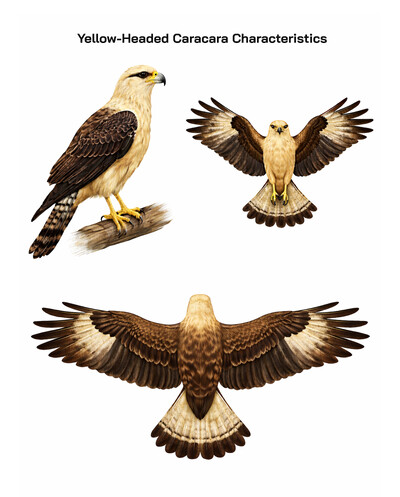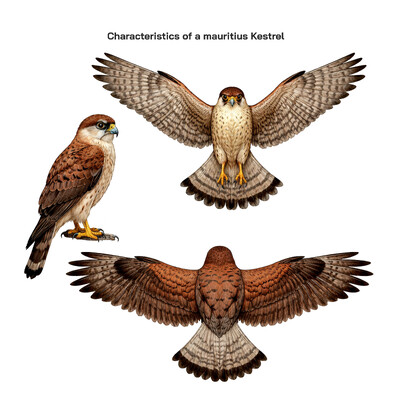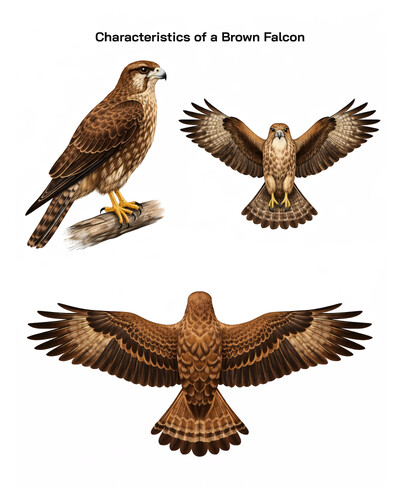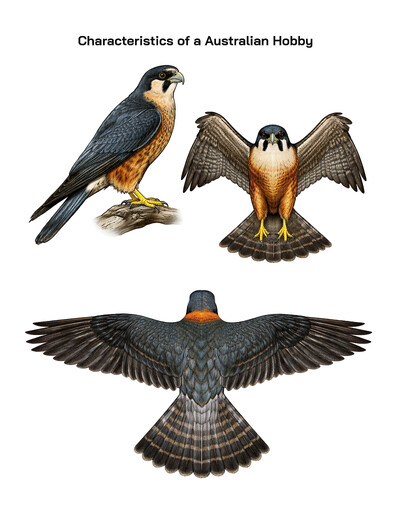
The Guadalupe caracara was a distinctive bird of prey once endemic to Guadalupe Island off the Pacific coast of Mexico. Known scientifically as Caracara lutosa, this species represents a unique example of island adaptation within the caracara group. Its characteristics reflected both its scavenging lifestyle and the ecological conditions of an isolated island environment. Although now extinct, the Guadalupe caracara remains an important subject in ornithology due to what it reveals about island ecosystems and human impact on wildlife.
Physically, the Guadalupe caracara was robust and heavily built compared to many mainland falcons. It possessed a strong, thick body with broad wings adapted more for short flights and gliding than for sustained high-speed pursuit. The plumage was predominantly dark brown to blackish, giving the bird a somber and imposing appearance. Like other caracaras, it had areas of bare facial skin around the beak, which likely varied in color and helped reduce feather fouling during feeding on carrion.
The head and beak structure were particularly well developed. The beak was large, sharply hooked, and powerful, suited for tearing flesh from carcasses and handling tough food items. Strong legs and talons supported its ground-oriented lifestyle, allowing it to walk confidently over rocky terrain and seabird nesting areas. Compared to more aerial falcons, its talons were adapted for gripping and manipulation rather than high-speed capture.
Behaviorally, the Guadalupe caracara was largely terrestrial and opportunistic. It spent much of its time on the ground or perched on low elevations, searching for food rather than actively hunting in flight. It was known to scavenge extensively, feeding on carrion, seabird remains, eggs, chicks, and other available organic matter. This flexible feeding strategy allowed it to survive in an island environment where food availability could fluctuate.
Habitat preference was closely tied to the geography of Guadalupe Island. The bird occupied coastal cliffs, open slopes, and areas near seabird colonies, where food resources were concentrated. As an island endemic species, it had a very limited range, making it highly specialized but also extremely vulnerable to environmental changes. Its nesting sites were likely located on cliffs or rocky ledges that provided visibility and protection.
Ecologically, the Guadalupe caracara played an important role as a scavenger and mid-level predator within the island ecosystem. By consuming carrion and waste material, it contributed to nutrient recycling and helped maintain cleanliness around seabird colonies. Its presence would have influenced population dynamics of other animals on the island, forming part of a delicate ecological balance.
The growth and reproductive characteristics of the Guadalupe caracara are believed to have been relatively slow, a common trait among island raptors. Such life-history traits, combined with a restricted habitat, made the species particularly sensitive to human disturbance. When humans arrived on Guadalupe Island, the caracara was persecuted due to perceived threats to livestock and game species.
The extinction of the Guadalupe caracara occurred in the early twentieth century, largely as a result of direct killing by humans. Its decline serves as a historical example of how quickly an endemic species can disappear when faced with habitat pressure and misunderstanding of its ecological role. Unlike many predators, it posed little actual threat to human interests, yet suffered severe consequences due to limited range and low population resilience.
Beyond its physical form and basic behavior, the Guadalupe caracara represents a deeper evolutionary story shaped by isolation, time, and ecological simplicity. Island environments often act as natural laboratories, and this bird was a product of such conditions. Over generations, the absence of competing predators and the predictability of coastal food sources gradually shaped its anatomy and temperament. Unlike continental raptors that evolved under constant pressure from rivals and prey capable of escape, this species adapted to an environment where patience, endurance, and opportunism mattered more than speed or agility. This evolutionary path likely explains why it developed a calmer, less wary disposition compared to many birds of prey, a trait that ultimately made it more vulnerable to human presence.
From an evolutionary perspective, the Guadalupe caracara offers insight into how island raptors diverge from their mainland relatives. Genetic isolation would have reduced gene flow, allowing traits that favored survival on rocky shores and seabird-dominated ecosystems to become fixed. Over time, natural selection favored individuals that conserved energy, tolerated long periods between meals, and exploited nontraditional food sources. This gradual specialization may have reduced its ability to adapt quickly when new threats appeared, highlighting one of the hidden costs of island specialization that is often overlooked.
Its interaction with seabird colonies was likely more complex than simple predation or scavenging. By consuming weak chicks, unhatched eggs, and organic waste, the bird may have indirectly improved colony health by limiting disease and reducing overcrowding. In this way, it functioned less as a destructive force and more as a regulator within the ecosystem. Such subtle ecological roles are often misunderstood, especially by humans unfamiliar with island dynamics, leading to misinterpretation of natural behavior as harmful rather than beneficial.
The Guadalupe caracara’s relationship with humans also reveals much about shifting perceptions of wildlife during the period of its decline. Early visitors to the island viewed nature through a utilitarian lens, valuing species primarily for their immediate usefulness or threat level. A bold, ground-walking raptor that showed little fear of humans was easily labeled a nuisance. Its behavior, shaped by centuries without human predators, likely appeared aggressive or intrusive rather than simply curious or opportunistic. This mismatch between animal behavior and human expectation played a significant role in sealing its fate.
Historical accounts suggest that the species was sometimes killed not out of necessity, but out of routine or sport. This pattern reflects a broader historical trend in which predators were eliminated preemptively, often without evidence of actual harm. The Guadalupe caracara thus joins a long list of species lost not because they failed ecologically, but because they failed to align with human tolerance. Its extinction illustrates how misunderstanding behavior can be just as destructive as habitat loss.
After its disappearance, the ecological consequences may not have been immediately obvious, but subtle changes likely followed. The loss of a dominant scavenger can lead to slower decomposition of organic material and altered nutrient flow, particularly in isolated ecosystems. Over time, such changes can ripple outward, affecting insect populations, plant growth, and even soil composition. These indirect effects often go undocumented, making extinctions seem less impactful than they truly are.
Today, the Guadalupe caracara exists only through preserved specimens, historical descriptions, and illustrations. These remnants provide valuable scientific information, allowing researchers to study its anatomy, feather structure, and proportions long after the species itself has vanished. Museums play a crucial role in this process, acting as repositories of lost biodiversity and offering future generations the chance to learn from past ecological mistakes. Each preserved specimen is not just a record of what once lived, but also a warning of how easily unique life forms can be erased.
In modern conservation discussions, the species is sometimes cited in debates about ethical responsibility and environmental memory. While technological advances have sparked conversations about species revival and genetic reconstruction, the Guadalupe caracara raises difficult questions about whether restoration can truly replace what was lost. An organism shaped by centuries of interaction with a specific environment cannot simply be recreated without restoring the entire ecological context that defined it. Its absence reminds us that conservation is not only about saving species, but about preserving relationships between organisms and their environments.
On a human level, the story of this bird resonates because it reflects a broader pattern of regret that follows recognition. Only after the Guadalupe caracara vanished did its ecological value become widely acknowledged. This delayed understanding is common in conservation history and underscores the importance of proactive protection rather than reactive mourning. Learning to value species for their roles rather than their perceived usefulness remains one of the greatest challenges in wildlife conservation.
Ultimately, the Guadalupe caracara stands as a symbol of irreplaceable loss and quiet warning. Its story teaches that adaptability has limits, that isolation can be both a strength and a weakness, and that human actions, even when unintentional, can permanently alter the course of natural history. Remembering this species is not merely an act of nostalgia, but an essential step toward building a more informed and respectful relationship with the living world.
When scientists and historians look beyond anatomy and basic ecology, the Guadalupe caracara reveals an even richer story about behavior, cognition, and the subtle ways animals adjust to isolation. One of the most intriguing aspects of this bird was likely its intelligence. Caracaras as a group are known for problem-solving ability, curiosity, and flexible thinking, and the Guadalupe caracara almost certainly shared these traits. Living on an island with limited resources would have favored individuals capable of learning quickly, remembering food locations, and adapting their behavior to changing conditions. This mental flexibility may have allowed the bird to exploit novel food sources, such as human refuse after early settlements appeared, even though that same curiosity ultimately increased its exposure to danger.
Social behavior is another area that remains largely unexplored but is essential to understanding the species as a living organism rather than a museum specimen. Unlike solitary high-speed falcons, island caracaras may have tolerated the presence of others of their kind, particularly around abundant food sources. Loose social interactions around carcasses or nesting areas could have reduced conflict and energy expenditure. Such tolerance would have been advantageous in a confined environment, where aggressive territoriality might waste valuable resources. This potential social adaptability hints at a bird that was not merely surviving but actively optimizing its lifestyle to island constraints.
The island’s climate also played a quiet but important role in shaping the Guadalupe caracara’s daily rhythm. Guadalupe Island experiences strong winds, variable fog, and limited freshwater sources. These conditions likely influenced when and how the bird was active. Rather than expending energy during harsh weather, it may have timed feeding and movement around calmer periods, conserving strength in an environment where energy efficiency was critical. Over time, this could have resulted in a slower-paced lifestyle compared to mainland raptors, reinforcing its reputation as a ground-focused and deliberate bird.
Another overlooked dimension is the bird’s influence on cultural perception, even during its lifetime. Early visitors often described it with a mix of fascination and hostility. Its fearless behavior challenged human expectations of wild animals, blurring the line between dominance and vulnerability. This psychological discomfort likely contributed to its persecution, as humans often respond aggressively to animals that do not behave as anticipated. In this sense, the Guadalupe caracara was not only a biological casualty but also a victim of human perception and misunderstanding.
From a broader evolutionary viewpoint, the extinction of the Guadalupe caracara removed a unique branch from the falcon family tree. Every species carries genetic solutions to survival problems, and this bird represented a distinct answer to life on an isolated oceanic island. Its disappearance reduced the overall evolutionary diversity of raptors, narrowing the range of adaptations available within the group. This loss is irreversible and highlights how extinction affects not just numbers, but the depth and richness of life’s evolutionary experiments.
Modern ecological studies often use extinct island species like the Guadalupe caracara as reference points when modeling ecosystem stability. By reconstructing its likely role, scientists can better understand how island systems function when intact. Such reconstructions suggest that the bird helped buffer the ecosystem against sudden changes by recycling nutrients and controlling opportunistic species. Without it, the island may have become more vulnerable to imbalances, particularly after the introduction of non-native animals by humans.
The emotional dimension of its story also deserves attention. Unlike mass extinctions driven by global forces, the Guadalupe caracara vanished within living memory of human settlement. This closeness in time makes its loss feel personal, almost conversational, as if history could have taken a different turn with just a small shift in awareness. It represents a moment when conservation, as a concept, had not yet fully emerged, leaving species unprotected simply because their value was not yet recognized.
In contemporary conservation education, the Guadalupe caracara serves as a quiet but powerful teaching tool. Its story helps illustrate that extinction is rarely caused by a single factor; rather, it is the result of overlapping pressures, misunderstandings, and missed opportunities. By examining its life in detail, conservationists can better communicate why protecting island species today is so urgent, especially as many face similar threats from habitat disturbance and human expansion.
Ultimately, the Guadalupe caracara was more than a scavenger or an island curiosity. It was a thinking, adapting organism shaped by a specific place and time, responding creatively to the challenges of isolation. Its extinction reminds us that intelligence and adaptability do not guarantee survival when external pressures move faster than evolution can respond. Remembering this bird in all its complexity encourages a deeper respect for living species that now occupy similarly fragile ecological spaces and depend on human understanding for their continued existence.
In summary, the Guadalupe caracara was characterized by its robust build, scavenging behavior, island adaptation, and ecological importance within a confined environment. Its extinction highlights the fragility of island ecosystems and the lasting impact of human activity on specialized wildlife. Today, the Guadalupe caracara stands as a powerful reminder of the need for conservation awareness and respect for ecological balance.