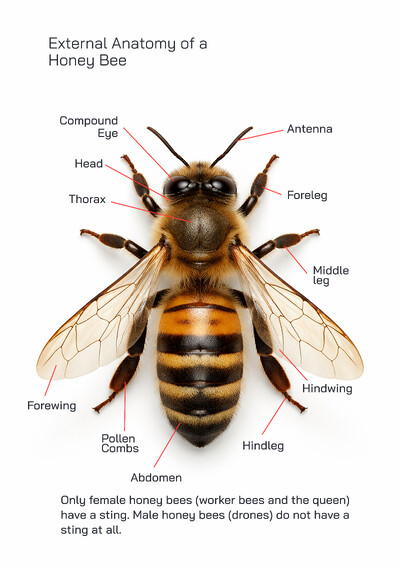
In a honeybee colony, the worker bee and the queen bee represent two distinctly specialized forms of the same species, shaped by biology, nutrition, and function rather than genetics alone. Although they originate from identical eggs, their physical appearance, internal characteristics, and roles differ dramatically, creating a highly efficient social structure that allows the colony to survive, reproduce, and thrive. Understanding the differences between a normal worker bee and a queen bee reveals how division of labor is embedded directly into their physical form.
The most noticeable physical difference between a worker bee and a queen bee lies in body size and shape. The queen bee is significantly larger, with a long, elongated abdomen that extends well beyond her folded wings. This elongated abdomen houses highly developed reproductive organs, enabling the queen to lay thousands of eggs during peak seasons. In contrast, a worker bee has a smaller, compact body with a shorter abdomen designed for agility and endurance rather than reproduction. The worker’s wings appear proportionally larger relative to body size, supporting long hours of flight during foraging.
Color and surface appearance also show subtle differences. Queen bees often appear smoother and more polished, with a less hairy body compared to worker bees. Worker bees possess more body hair, particularly on the thorax and legs, which plays a critical role in pollen collection and transport. Specialized pollen baskets on the worker bee’s hind legs are entirely absent in the queen, reflecting their completely different lifestyles and responsibilities.
Internally, the biological characteristics of the two bees diverge even more sharply. The queen bee has fully developed ovaries capable of continuous egg production, making her the sole reproductive individual in the colony. Her body is physiologically optimized for longevity and reproduction, often living several years under ideal conditions. Worker bees, by contrast, have underdeveloped reproductive organs and are typically sterile. Their internal systems are optimized for tasks such as nectar processing, wax production, and food distribution rather than reproduction.
Behavioral characteristics further highlight the contrast between the two. The queen bee’s primary function is to maintain colony continuity through egg-laying and pheromone release. These pheromones regulate colony behavior, suppress worker reproduction, and maintain social harmony. The queen rarely leaves the hive after mating and does not participate in daily labor. Worker bees exhibit highly active and varied behavior, transitioning through different roles as they age. Their lives involve nursing larvae, cleaning cells, building wax comb, guarding the hive, and eventually foraging outside.
Defensive and survival traits also differ between the two. Worker bees possess functional stingers used to defend the colony, though stinging results in their death. The queen also has a stinger, but it is primarily used to eliminate rival queens rather than for defense against predators. The queen’s survival is prioritized by the colony, and workers actively protect her at all times, as the loss of the queen threatens colony stability.
Diet during development is a key factor behind these differences. Queen bees are fed exclusively on royal jelly throughout their larval stage, triggering hormonal and anatomical changes that lead to reproductive maturity and larger body size. Worker bees receive royal jelly only briefly before transitioning to a diet of pollen and nectar, which limits reproductive development and supports functional labor traits. This nutritional divergence is the foundation of caste differentiation within the hive.
Lifespan differences reflect their biological roles. A queen bee may live several years, ensuring long-term colony continuity. Worker bees typically live only a few weeks during active seasons due to intense labor demands, though some may survive longer during inactive periods. This contrast underscores how physical structure, metabolism, and function are aligned with expected lifespan and contribution to the colony.
From an evolutionary perspective, these differences represent an advanced example of social specialization. The queen bee embodies reproduction and genetic continuity, while worker bees represent adaptability, efficiency, and cooperative survival. Their contrasting physical appearances and characteristics are not random but precisely shaped by natural selection to support a highly organized social system.
Beyond outward appearance and basic reproductive roles, worker bees and queen bees differ profoundly at the hormonal and molecular level. These internal differences govern not only physical development but also behavior, lifespan, and responsiveness to environmental signals. Queen bees maintain a unique hormonal balance that supports continuous egg production and suppresses aging processes. Elevated levels of reproductive hormones and specialized gene expression patterns allow the queen’s body to prioritize cellular repair and long-term stability. Worker bees, in contrast, experience hormonal shifts throughout their lives that align with task transitions, resulting in faster aging and shorter lifespans.
Metabolic specialization further distinguishes the two castes. Queen bees possess a metabolism optimized for sustained internal activity rather than physical exertion. Energy intake is efficiently converted into egg production, pheromone synthesis, and tissue maintenance. Worker bees exhibit a far more dynamic metabolic profile, adjusting energy use depending on task demands. Foragers, for example, operate at extremely high metabolic rates to support prolonged flight, while nurse bees rely on internal energy reserves to produce nutrient-rich secretions for larvae. These metabolic differences are tightly linked to caste-specific physiology.
The nervous system also reflects caste differentiation. Worker bees have neural adaptations that support learning, memory, and sensory processing, particularly related to navigation, odor recognition, and communication. Their brains are highly plastic, allowing rapid behavioral adaptation to environmental conditions. Queen bees, while still neurologically functional, show reduced emphasis on learning and sensory exploration. Their neural investment is directed more toward maintaining internal physiological balance and pheromone signaling rather than external interaction.
Sensory structures differ subtly but significantly. Worker bees possess highly developed antennae receptors used for detecting floral scents, pheromones, and environmental cues. Their compound eyes are optimized for motion detection and spatial orientation during flight. Queen bees retain functional sensory organs but with reduced sensitivity compared to workers, reflecting their largely hive-bound existence. This sensory divergence reinforces behavioral specialization and minimizes redundancy within the colony.
Communication roles provide another layer of distinction. While worker bees actively exchange information through tactile contact, chemical signals, and movement-based communication, the queen’s communication is almost entirely chemical. Her pheromones act as a biological command system, influencing worker behavior, reproduction suppression, task organization, and colony cohesion. Unlike workers, the queen does not respond dynamically to incoming signals; instead, she serves as a stable source of regulatory cues that structure colony function.
Structural differences extend to internal organ allocation. In queen bees, a substantial proportion of body volume is devoted to reproductive organs, reducing space for structures related to physical labor. Worker bees allocate internal resources toward glands used for wax secretion, food processing, and pheromone production. These glands undergo cycles of activation and regression depending on the worker’s age and role, highlighting a level of physiological flexibility absent in queens.
Immune system function also varies between castes. Queen bees benefit from enhanced immune stability, protecting them from infection over long lifespans within the hive. Worker bees experience fluctuating immune investment, often sacrificing long-term immunity for immediate task performance. Foraging workers, in particular, face increased pathogen exposure and oxidative stress, contributing to accelerated aging. This difference reflects a colony-level strategy in which individual worker longevity is secondary to overall productivity.
Developmental timing introduces further divergence. Queen bees complete development faster than worker bees despite achieving larger size, due to the continuous intake of nutrient-rich royal jelly. This accelerated development enables rapid replacement of queens when necessary, a critical survival mechanism for the colony. Worker development proceeds more gradually, allowing finer tuning of structural and functional traits suited to labor-intensive roles.
Reproductive suppression in worker bees is another critical distinction. Although workers retain rudimentary reproductive structures, these are actively inhibited by queen pheromones and social regulation. This suppression is reversible under certain conditions, such as queen loss, demonstrating that worker sterility is socially enforced rather than genetically fixed. Queens, by contrast, maintain uninterrupted reproductive capability once established, reinforcing their central biological role.
From a colony-level perspective, worker and queen differentiation represents an extreme form of biological efficiency. Rather than producing identical individuals capable of all tasks, the colony invests in highly specialized forms that excel in specific functions. This specialization reduces internal competition, increases productivity, and enhances resilience under environmental stress. The queen provides genetic continuity and regulatory stability, while workers deliver adaptability and labor diversity.
Environmental stress responses also differ between the two castes. Worker bees respond rapidly to changes in temperature, food availability, and threats, adjusting behavior and task allocation accordingly. Queen bees are buffered from environmental fluctuations by worker care, allowing them to maintain consistent reproductive output. This division ensures that short-term challenges do not disrupt long-term colony reproduction.
At an evolutionary scale, the divergence between worker and queen bees demonstrates how nutrition-driven developmental pathways can create radically different adult forms within a single species. This system allows rapid adaptation without genetic change, relying instead on flexible developmental programming. The result is a social organism in which individual bodies function as integrated components of a larger biological unit.
A further layer of distinction between worker bees and queen bees appears in how their bodies manage stress and cellular damage over time. Queen bees exhibit enhanced cellular maintenance mechanisms that slow tissue degradation and support long-term survival. Their cells show higher resistance to oxidative stress, allowing vital organs to remain functional for years. Worker bees, by contrast, experience accelerated cellular wear due to intense physical activity, exposure to environmental hazards, and repeated metabolic strain. This difference reflects an evolutionary strategy where the longevity of the reproductive individual is prioritized over that of laborers.
Epigenetic regulation is another critical factor separating queens from workers. Although both castes share the same genetic blueprint, chemical modifications to DNA expression determine which genes are activated or silenced. In queen bees, genes associated with fertility, longevity, and pheromone production are consistently expressed. In worker bees, genes related to muscle development, sensory perception, detoxification, and task performance are emphasized. These epigenetic patterns are stable yet responsive, enabling workers to adjust physiology as they shift roles within the colony.
Flight physiology also differs subtly but significantly. Worker bees develop flight muscles optimized for repetitive, long-distance travel, allowing them to forage efficiently over wide areas. Their thoracic musculature is proportionally stronger relative to body size, supporting frequent takeoffs and landings. Queen bees, while capable of flight during mating and swarming events, possess flight muscles that are less endurance-oriented. After mating, the queen’s abdomen enlarges further, reducing flight efficiency and reinforcing her permanent association with the hive interior.
Thermal regulation within the colony highlights caste-specific contributions. Worker bees actively regulate hive temperature through coordinated behaviors such as wing fanning, water distribution, and clustering. Their bodies are adapted for rapid heat generation and dissipation, enabling precise environmental control. The queen bee benefits from this collective regulation and does not participate directly in thermal management. Her physiology assumes a stable internal environment maintained by worker activity.
Another unique difference lies in how each caste interacts with pathogens and toxins. Worker bees possess detoxification enzymes that help process environmental chemicals encountered during foraging, including plant compounds and agricultural residues. These enzymes are less emphasized in queens, who remain protected within the hive and receive filtered nutrition through worker feeding. This division of exposure risk allows the colony to shield its reproductive core from external threats.
The aging process itself unfolds differently in workers and queens. In worker bees, aging is closely tied to behavior rather than chronological time. Individuals that transition early to foraging roles age more rapidly than those that remain in nursing roles longer. Queens, however, exhibit a decoupling of aging from activity level. Despite constant egg production, their biological aging progresses slowly, demonstrating a rare case where high reproductive output does not shorten lifespan.
Social feedback mechanisms further reinforce caste roles. Worker bees constantly assess the queen’s health and productivity through pheromonal cues. If her signal weakens, workers initiate processes to rear a replacement, demonstrating that the queen’s authority is conditional rather than absolute. Worker bees, in turn, are regulated by both queen signals and peer interactions, creating a self-correcting system that maintains balance without centralized control.
Colony resilience also depends on caste-specific flexibility. In emergency situations, worker bees can modify behavior and physiology to compensate for sudden changes, such as loss of foragers or shifts in food availability. Queens lack this behavioral flexibility but provide stability through consistent reproduction. This contrast ensures that the colony can respond rapidly to short-term challenges while maintaining long-term continuity.
Energy allocation strategies differ sharply between the two castes. Worker bees invest energy into movement, secretion, construction, and defense, often operating near their physiological limits. Queens channel energy almost exclusively into reproduction and chemical signaling. This separation prevents resource competition between essential functions and allows the colony to operate with maximum efficiency.
From an ecological standpoint, worker–queen differentiation allows honeybee colonies to function as superorganisms. Individual bees resemble specialized cells within a larger body, each optimized for a specific task. The queen functions as the reproductive core, while workers act as the circulatory, sensory, and defensive systems. This level of integration exceeds simple cooperation and represents one of the most advanced forms of biological organization.
In evolutionary terms, the worker–queen distinction demonstrates how natural selection can act at the group level rather than solely on individuals. Traits that benefit the colony, even at the expense of individual longevity, are favored when they enhance collective survival and reproduction. Worker sterility and shortened lifespan are not failures of evolution but essential features of a system designed for efficiency and resilience.
Ultimately, the continued comparison of worker bees and queen bees reveals a biological partnership built on contrast rather than similarity. Every difference in anatomy, physiology, behavior, and lifespan serves a precise purpose within the colony framework. The queen embodies continuity, stability, and genetic transmission, while workers represent adaptability, labor, and environmental engagement. Together, these two forms transform a single species into a highly coordinated living system capable of thriving across diverse environments and challenges.
In conclusion, the differences between worker bees and queen bees extend far beyond visible traits and basic roles. They encompass hormonal regulation, metabolism, neural structure, sensory capacity, immunity, development, and environmental responsiveness. These distinctions are not accidental but represent a finely tuned biological strategy in which form, function, and lifespan are precisely aligned with social purpose. Together, worker and queen bees exemplify one of the most advanced expressions of cooperative specialization in the natural world.
In summary, the difference between a normal worker bee and a queen bee is evident in body size, abdomen length, hair coverage, internal anatomy, behavior, lifespan, and function within the colony. While the queen bee is physically designed for reproduction and chemical regulation, the worker bee is built for labor, defense, and environmental interaction. Together, these complementary forms create one of the most sophisticated biological societies found in nature.