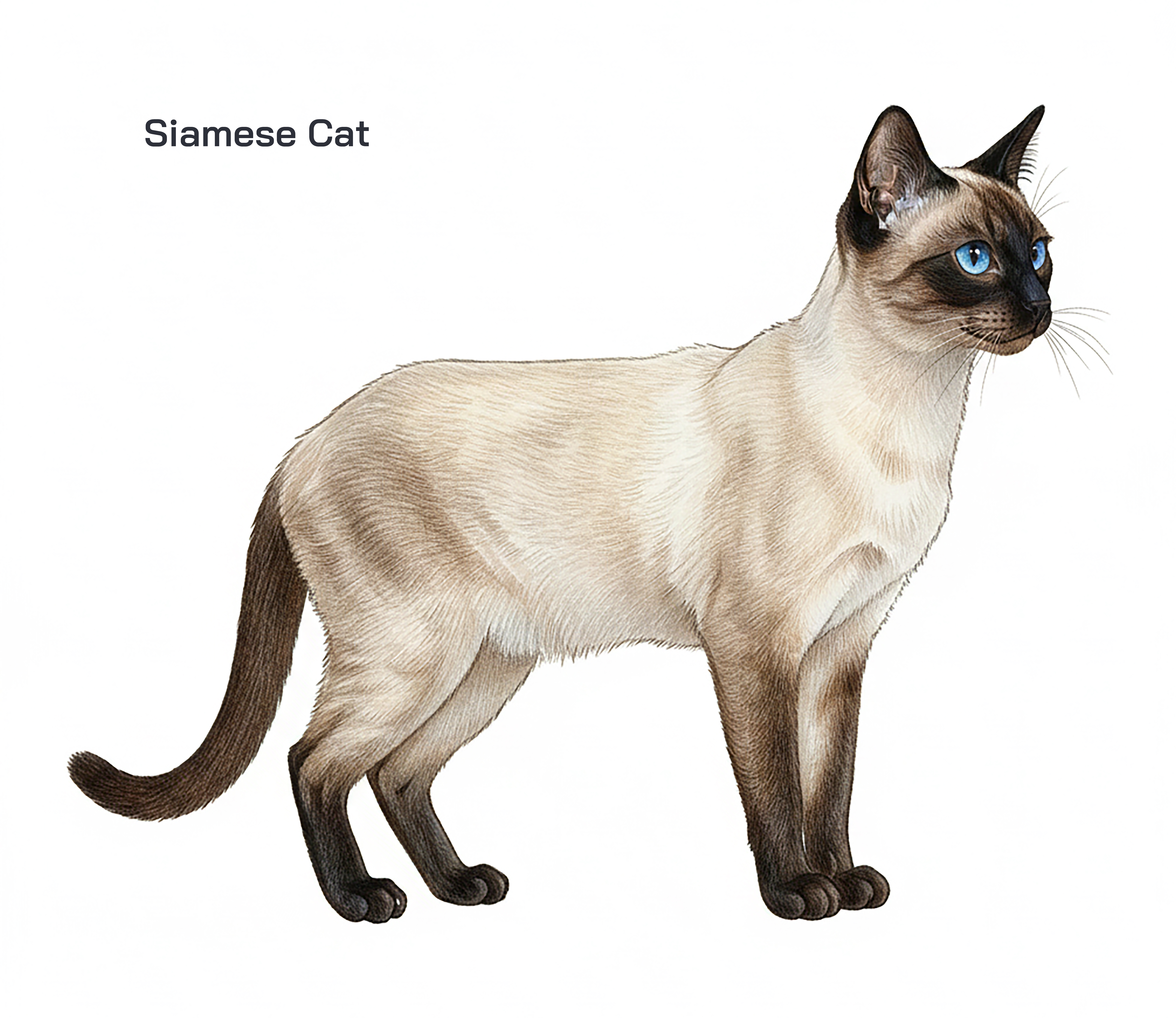
The Siamese cat is one of the most distinctive and recognizable cat breeds in the world, admired for its striking appearance, expressive personality, and deep connection with humans. Known for its sleek body, bright blue eyes, and color-pointed coat, the Siamese cat stands apart from many other domestic cats due to its vocal nature and strong social instincts. The characteristics of the Siamese cat reflect a long history of close interaction with people, making it a breed that thrives on companionship and engagement.
Physically, the Siamese cat is elegant and refined, with a long, slender body that emphasizes grace rather than bulk. The legs are slim yet muscular, supporting a flexible frame built for agility and movement. One of the most defining physical traits is the wedge-shaped head, which tapers smoothly from the ears to the muzzle. The ears are large and set wide apart, enhancing the breed’s alert and inquisitive expression. The eyes are almond-shaped and always blue, ranging from pale ice blue to deep sapphire tones, adding to the cat’s intense and intelligent gaze.
The coat of the Siamese cat is short, fine, and lies close to the body. Unlike many breeds, it has no thick undercoat, which gives it a smooth, glossy appearance and results in relatively low shedding. The most famous feature of the coat is the color-point pattern, where darker coloration appears on the ears, face, legs, tail, and paws, while the rest of the body remains lighter. These points develop due to temperature-sensitive pigmentation, making the Siamese cat a fascinating example of genetic expression. Common point variations include seal, chocolate, blue, and lilac, each giving the breed a slightly different visual character.
Temperament is where the Siamese cat truly distinguishes itself. This breed is known for being extremely social and emotionally expressive. Siamese cats form strong bonds with their owners and often choose one person as their primary companion. They enjoy being involved in daily activities and dislike being ignored. Unlike independent breeds, the Siamese cat seeks attention and interaction, often following its owner from room to room and demanding engagement through sound or physical closeness.
One of the most well-known characteristics of the Siamese cat is its vocal nature. These cats are famous for their loud, distinctive voices and their tendency to “talk” to humans. They use a wide range of vocal sounds to express needs, opinions, and emotions. This communication is not random; it reflects the breed’s intelligence and desire for social interaction. Owners often describe conversations with their Siamese cats, as the breed responds actively when spoken to.
Intelligence is another defining feature of the Siamese cat. This breed is quick to learn routines, recognize people, and understand household patterns. Siamese cats can be trained to perform simple tasks, walk on a leash, or play interactive games. Their curiosity drives them to explore their environment, climb furniture, and investigate new objects. Mental stimulation is essential for this breed, as boredom can lead to restlessness or unwanted behavior.
In terms of behavior, Siamese cats are energetic and playful well into adulthood. They enjoy climbing, jumping, and engaging in interactive play sessions. Despite their active nature, they are also affectionate lap cats that enjoy close physical contact. Their emotional sensitivity allows them to respond strongly to human moods, making them comforting companions during quiet moments.
The Siamese cat has ancient origins, tracing back to Thailand, formerly known as Siam. Historical records and artwork depict these cats as companions of royalty and guardians of temples. Their association with nobility contributed to their reputation as elegant and prized animals. When introduced to the Western world, the Siamese cat quickly gained popularity due to its unusual appearance and engaging personality.
Care requirements for Siamese cats are relatively simple compared to long-haired breeds. Their short coat requires minimal grooming, usually limited to occasional brushing to remove loose hair. Because they lack a dense undercoat, Siamese cats are sensitive to cold and prefer warm indoor environments. A balanced diet and regular veterinary care support their long lifespan, which often extends well into the teenage years.
Socially, Siamese cats do best in homes where they receive regular attention. They can live happily with families, singles, or even other pets, provided companionship is available. Many owners choose to keep more than one Siamese cat to prevent loneliness. Their adaptability allows them to adjust well to indoor living, where they can form strong emotional bonds with their human family.
The Siamese cat is one of the most iconic and emotionally expressive domestic cat breeds in the world, instantly recognizable for its striking blue eyes, elegant body structure, and distinctive color-point coat. Beyond its physical beauty, the Siamese cat is celebrated for its intelligence, vocal communication, and unusually strong attachment to humans. Unlike many cat breeds that value independence, the Siamese cat thrives on interaction, companionship, and mental engagement, making it a breed that behaves more like a social partner than a distant pet. Its characteristics are the result of centuries of natural development and selective breeding that emphasized both appearance and temperament.
Physically, the Siamese cat represents refinement and balance rather than strength or bulk. Its body is long, lean, and tubular, supported by slender yet strong legs that allow graceful movement and impressive agility. The hind legs are slightly longer than the front, giving the cat a natural posture suited for jumping and climbing. The tail is long and tapering, contributing to the breed’s sleek silhouette. This overall structure gives the Siamese cat an athletic elegance that distinguishes it clearly from rounder or heavier-bodied breeds.
The head shape of the Siamese cat is one of its most defining features. Modern Siamese cats have a long, wedge-shaped head that narrows smoothly from the wide-set ears to the muzzle. The ears are large, open, and angular, enhancing the breed’s alert and curious expression. The almond-shaped eyes are always blue, a defining trait that results from the same genetic mechanism responsible for the color-point coat. These eyes are not only visually striking but also highly expressive, often reflecting the cat’s emotional state and attentiveness to its surroundings.
The coat of the Siamese cat is short, fine, and tightly fitted to the body, giving it a smooth and glossy appearance. The absence of a thick undercoat means the fur lies flat and highlights the cat’s muscular structure. Shedding is minimal compared to many other breeds, making grooming relatively easy. The color-point pattern is one of the most fascinating aspects of the Siamese coat. This pattern is caused by a temperature-sensitive genetic trait that allows darker pigmentation to develop on cooler parts of the body, such as the ears, face, legs, tail, and paws, while the warmer central body remains lighter in color. This means that Siamese kittens are born almost white and develop their points gradually as they grow.
Temperament is where the Siamese cat truly sets itself apart. This breed is intensely social and emotionally driven, forming deep bonds with its human companions. Siamese cats are known to follow their owners throughout the home, observe activities closely, and insist on being included in daily routines. They often choose a favorite person and show strong loyalty, seeking physical closeness and constant interaction. This deep attachment means they do not cope well with prolonged loneliness and are happiest in environments where companionship is consistent.
One of the most famous traits of the Siamese cat is its vocalization. Siamese cats are highly talkative and possess a loud, distinctive voice that they use frequently to communicate. These vocalizations are not random noises but purposeful expressions of needs, emotions, and opinions. Siamese cats often respond when spoken to and may engage in long “conversations” with their owners. This vocal nature reflects the breed’s intelligence and desire for interaction, making them one of the most communicative cat breeds in the world.
Intelligence is a defining strength of the Siamese cat. These cats are quick learners, capable of understanding routines, recognizing individual people, and adapting to new environments. They enjoy interactive toys, puzzle feeders, and games that challenge their minds. Many Siamese cats can be trained to walk on a leash, fetch objects, or perform simple tricks. Their curiosity drives them to explore high places, open doors, and investigate anything new in their environment. Without sufficient mental stimulation, Siamese cats may become bored, which can lead to excessive vocalization or mischievous behavior.
Behaviorally, Siamese cats maintain a playful and energetic nature well into adulthood. They enjoy climbing, jumping, and interactive play that mimics hunting behavior. At the same time, they are deeply affectionate and enjoy resting close to their owners, often curling up on laps or sleeping beside them. Their emotional sensitivity allows them to respond to changes in household mood, making them comforting companions during stressful or quiet times. This emotional awareness strengthens the bond between Siamese cats and their humans.
The origins of the Siamese cat trace back hundreds of years to Thailand, formerly known as Siam. Historical manuscripts and artwork depict these cats as sacred companions of royalty and guardians of temples. They were believed to bring good fortune and were highly valued for their beauty and temperament. When Siamese cats were introduced to Europe and North America, their unusual appearance and engaging personality quickly captured attention, leading to widespread popularity and the establishment of formal breed standards.
Caring for a Siamese cat is relatively straightforward but requires emotional commitment. Their short coat needs minimal grooming, usually limited to occasional brushing or wiping with a soft cloth to remove loose hair. Because they lack a thick undercoat, Siamese cats are sensitive to cold temperatures and prefer warm, indoor environments. Nutrition plays an important role in maintaining their lean physique, and a balanced diet supports their high activity levels and long lifespan, which often ranges from fifteen to twenty years.
Socially, Siamese cats adapt well to a variety of households, including families with children, single individuals, and homes with other pets. They often benefit from having another companion, especially if their owners are frequently away. When properly socialized, Siamese cats coexist peacefully with other cats and even dogs, provided introductions are gradual and respectful.
The Siamese cat is one of the most studied, admired, and emotionally engaging domestic cat breeds in the world. Its reputation extends far beyond its striking physical appearance, reaching into areas of behavior, genetics, communication, and human–animal relationships. Unlike many cat breeds that are valued primarily for appearance or independence, the Siamese cat is defined by its intense social nature and psychological closeness to humans. This breed does not simply live alongside people; it actively participates in human life, forming bonds that resemble companionship more than ownership.
From a biological standpoint, the Siamese cat is a refined example of feline athleticism. Its body is designed for efficiency, flexibility, and precision rather than brute strength. The long, lean torso supports quick directional changes, while the strong but slim limbs allow for exceptional jumping ability and balance. The slightly longer hind legs contribute to explosive upward movement, making Siamese cats natural climbers. This physical structure reflects their high energy levels and curiosity-driven behavior. Unlike heavier breeds that conserve energy, Siamese cats are constantly alert and engaged with their environment.
One of the most scientifically fascinating aspects of the Siamese cat is its coat coloration. The color-point pattern is the result of a temperature-sensitive genetic mutation that affects pigment production. The enzyme responsible for melanin synthesis functions only in cooler areas of the body. As a result, darker pigmentation develops on extremities such as the ears, face, paws, and tail, while the warmer core of the body remains lighter. This means that environmental temperature can subtly influence coat coloration throughout the cat’s life. Siamese cats raised in cooler environments may appear darker overall, while those in warmer climates may retain lighter body tones. This unique genetic expression makes the Siamese cat an important subject in studies of gene–environment interaction.
The blue eye color of the Siamese cat is also genetically linked to this pigmentation mechanism. The absence of pigment in the iris causes light to scatter, producing the vivid blue color rather than brown or green. While visually striking, this genetic trait can also influence sensory perception. Siamese cats often demonstrate heightened sensitivity to sound and movement, which may contribute to their alertness and vocal responsiveness.
Behaviorally, the Siamese cat is exceptional among domestic cats. It exhibits a level of social dependency that is uncommon in feline species. Siamese cats actively seek interaction, initiate contact, and respond emotionally to human behavior. They often mirror the routines of their owners, adjusting sleep patterns and activity levels to match household rhythms. This adaptability strengthens the emotional bond and reinforces the cat’s role as a companion rather than a passive presence.
Vocal communication is one of the most defining traits of the Siamese cat. Unlike other breeds that vocalize primarily when distressed or hungry, Siamese cats use sound as a primary communication tool. Their vocal range includes varied tones, pitches, and intensities that correspond to different emotional states. These cats appear to understand cause and effect in communication, learning that vocalization elicits responses from humans. Over time, this leads to increasingly complex interaction patterns that resemble conversation. This behavior reflects advanced cognitive processing and emotional intelligence.
The intelligence of the Siamese cat is expressed not only through learning ability but also through problem-solving and emotional reasoning. These cats quickly learn how to open doors, access hidden spaces, and manipulate objects to achieve desired outcomes. They also demonstrate memory retention, recognizing people even after long absences. Siamese cats often anticipate events such as feeding times or departures, reacting emotionally to changes in routine. This awareness highlights their strong attachment to structure and predictability.
Emotionally, Siamese cats are highly sensitive. They respond strongly to human moods, often becoming more affectionate during times of stress or withdrawal. This sensitivity makes them particularly comforting companions but also means they are vulnerable to emotional neglect. Extended periods of isolation can lead to anxiety-related behaviors such as excessive vocalization, destructive play, or withdrawal. For this reason, Siamese cats thrive best in environments where companionship is consistent and engagement is frequent.
Historically, the Siamese cat’s close bond with humans is not accidental. In its native region, it was selectively protected and valued for both companionship and symbolic significance. This long-standing relationship with people shaped the breed’s social instincts over generations. When introduced to other parts of the world, the Siamese cat retained these traits, standing apart from breeds that evolved primarily through appearance-based selection.
Care for a Siamese cat extends beyond physical maintenance. While grooming needs are minimal due to the short coat, emotional care is essential. These cats require interactive play, mental stimulation, and social presence to remain balanced. Toys that encourage problem-solving, climbing structures, and regular human interaction are not luxuries but necessities for this breed. Without stimulation, a Siamese cat’s intelligence can manifest as restlessness or behavioral challenges.
Health considerations for Siamese cats often relate to their lean build and active metabolism. They typically maintain a slender physique throughout life, but this requires proper nutrition. Diets rich in quality protein support muscle tone and energy levels. Because they are highly active, underfeeding can lead to weight loss, while overfeeding may disrupt their natural balance. Regular veterinary care supports their generally long lifespan, which frequently extends into late adulthood.
Social adaptability is another strength of the Siamese cat. While deeply bonded to humans, many Siamese cats can coexist harmoniously with other pets if introduced correctly. They often benefit from having another companion, particularly another social cat, to share interaction and play. However, they still seek human attention and do not replace human bonds with animal companionship alone.
In a modern context, the Siamese cat represents a shift in how people view pets. Rather than being ornamental or independent animals, Siamese cats exemplify emotional reciprocity. They respond, react, and engage in ways that feel deeply personal to their owners. This mutual relationship creates a dynamic bond that evolves over time, shaped by shared experiences and daily interaction.
In conclusion, the Siamese cat is not merely a breed defined by appearance but a complex, emotionally intelligent companion shaped by genetics, history, and human connection. Its unique biology, expressive communication, high intelligence, and deep social needs make it one of the most engaging domestic cats in the world. Owning a Siamese cat means committing to interaction, understanding, and emotional presence. In return, the breed offers loyalty, affection, and a level of companionship that few other cats can match, making it a truly extraordinary member of the feline world. The Siamese cat is far more than a visually striking breed. It is an intelligent, emotionally expressive, and deeply social companion that forms profound bonds with humans. Its elegant appearance, unique genetics, vocal communication, and affectionate nature make it one of the most engaging cat breeds in the world. Owning a Siamese cat means welcoming not just a pet, but a lively, perceptive, and devoted presence into daily life—one that thrives on connection, interaction, and shared experience.
In summary, the Siamese cat is defined by its elegant body structure, striking blue eyes, vocal personality, and high intelligence. Its affectionate and interactive nature sets it apart from more reserved feline breeds. With proper care, attention, and companionship, the Siamese cat becomes not just a pet but an expressive and deeply connected member of the household. The characteristics of the Siamese cat make it an ideal choice for those seeking an engaging, loyal, and emotionally responsive feline companion.