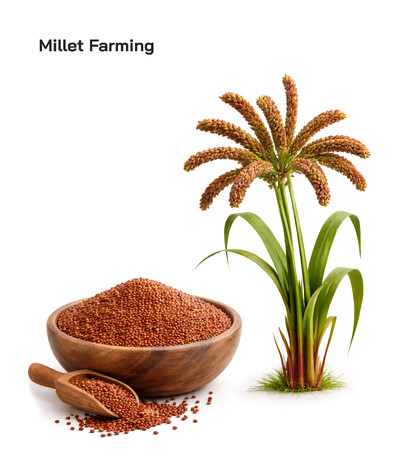
Sorghum, commonly known as jowar, is a highly resilient millet crop scientifically identified as Sorghum bicolor and widely cultivated for its grain and fodder value. It is one of the most climate-resilient cereals, making it a cornerstone of dryland and semi-arid agriculture across the world. Sorghum farming is particularly valued for its ability to produce stable yields under limited rainfall, high temperatures, and marginal soil conditions. Because of this adaptability, jowar has played a vital role in food security for centuries, especially in regions prone to drought and erratic weather patterns.
The farming process of sorghum begins with appropriate land selection and careful field preparation. Sorghum performs best in open fields that receive abundant sunlight throughout the day, as light availability directly influences tillering, flowering, and grain formation. The land is initially ploughed deeply to loosen the soil, allowing for good root penetration and improved moisture infiltration. This is followed by secondary tillage operations that break down soil clods and create a fine seedbed. Proper land preparation ensures uniform seed placement, better germination, and strong early seedling establishment. In many traditional systems, organic matter such as decomposed farmyard manure is incorporated at this stage to enhance soil structure and long-term fertility.
Sowing is a critical step in sorghum cultivation and is usually carried out at the onset of the rainy season or when adequate soil moisture is available. Seeds are sown directly in the field, as sorghum establishes best without transplanting. Uniform seed depth and spacing are maintained to ensure balanced plant population and reduce competition for nutrients, water, and sunlight. Under favorable temperature and moisture conditions, germination occurs quickly, and seedlings emerge uniformly. Early crop establishment is essential, as it allows the plants to develop deep root systems that help them withstand later moisture stress.
As the crop enters the vegetative growth stage, field management focuses on weed control and soil aeration. Weeds compete aggressively with young sorghum plants for nutrients and moisture, particularly during the early growth phase. Timely weeding and intercultural operations help keep the field clean and improve soil aeration around the root zone. Sorghum’s strong root system allows it to recover well from early stress when proper field management is maintained. Once established, the crop becomes increasingly competitive against weeds due to its height and canopy development.
Soil suitability is one of sorghum’s greatest advantages, as it can grow in a wide range of soil types. Sandy loam to loamy soils are considered ideal, but sorghum can also tolerate relatively poor soils where other cereals fail. Good drainage is important, as prolonged waterlogging negatively affects root health and nutrient uptake. Sorghum is known for its ability to tolerate slightly acidic to moderately alkaline soils, which further broadens its cultivation range. Maintaining soil fertility through organic inputs and sustainable practices supports consistent grain formation and long-term productivity.
Terrain plays a significant role in sorghum farming, particularly in dryland agriculture. The crop is well suited to flat plains and gently sloping lands where water runoff can be managed efficiently. In semi-arid regions, sorghum is often grown on rainfed uplands where irrigation is limited or unavailable. Its deep and extensive root system allows it to extract moisture from deeper soil layers, making it suitable for terrains with low water-holding capacity. In regions with uneven terrain, contour farming and moisture conservation practices are often used to reduce soil erosion and improve water retention.
Irrigation management in sorghum farming is generally minimal compared to other cereals, as the crop is naturally drought tolerant. In rainfed systems, sorghum relies primarily on seasonal rainfall. However, in irrigated conditions, timely and moderate irrigation during critical growth stages such as flowering and grain filling can significantly enhance yield. Excessive irrigation is avoided, as it can lead to lodging, nutrient leaching, and increased disease pressure. Modern irrigation methods such as controlled surface irrigation or drip systems are increasingly adopted in some regions to improve water-use efficiency and stabilize production.
Climate is one of the most important factors influencing sorghum cultivation. The crop thrives in warm to hot climates with high sunlight intensity. Optimal growth occurs under high temperatures, which support rapid vegetative growth and effective grain development. Sorghum is particularly well adapted to regions with low and erratic rainfall, where its drought tolerance provides a clear advantage. Cool temperatures slow growth and delay flowering, while frost can cause severe damage, which is why sorghum is primarily grown as a summer or monsoon-season crop in many parts of the world.
Environmental conditions such as air circulation, humidity, and sunlight exposure further influence sorghum productivity. Open fields with good airflow help reduce the risk of fungal diseases, particularly during the flowering stage. Sorghum’s waxy leaf surface and efficient water-use mechanisms reduce moisture loss, allowing the plant to maintain physiological activity even under heat stress. Its ability to remain productive under harsh environmental conditions has made it a preferred crop in regions facing climate variability and increasing water scarcity.
Flowering and grain development occur after the vegetative stage, with panicles emerging from the top of the plant. Successful pollination leads to grain filling, which determines final yield. Proper moisture availability during this stage supports grain size and quality. Harvesting is carried out once the grains reach physiological maturity and moisture levels drop sufficiently for safe storage. Sorghum grains are valued for their storage stability, which allows them to be stored for long periods without significant quality loss, an important trait in food security systems.
Sorghum is cultivated extensively across several major regions of the world. Africa is considered the primary center of origin and remains one of the largest producers, particularly in semi-arid zones where it serves as a staple food. South Asia, especially India, is another major cultivation region where jowar plays a key role in traditional diets and dryland farming systems. Sorghum is also widely grown in parts of China, Southeast Asia, and Australia, as well as in the Americas, including the United States, where it is used for food, animal feed, and industrial purposes. Its global distribution reflects its adaptability and importance as a resilient cereal crop.
Beyond the general cultivation steps and environmental requirements, sorghum farming involves several advanced agronomic considerations that significantly influence productivity, resilience, and long-term sustainability. One such aspect is varietal selection based on end use. Farmers choose different sorghum cultivars depending on whether the crop is intended for human consumption, fodder, dual-purpose use, or industrial applications. Grain-focused varieties emphasize uniform panicles and seed hardness, while fodder types prioritize biomass and leafiness. Selecting varieties adapted to local photoperiod sensitivity and rainfall patterns helps synchronize flowering with favorable climatic windows, reducing the risk of yield loss.
Seed quality and pre-sowing practices are another critical yet often underemphasized component of sorghum farming. Using certified, high-vigor seed ensures uniform emergence and reduces early-stage crop failure. In many regions, farmers practice seed treatment using natural or biological agents to protect seedlings from soil-borne pests and diseases during germination. Proper seed handling and storage before sowing help maintain viability, especially in warm climates where seed deterioration can occur rapidly.
Nutrient management in sorghum cultivation extends beyond basic fertility. While sorghum is known for its ability to grow under low-input conditions, balanced nutrient availability plays a crucial role in achieving optimal yields. Nitrogen influences vegetative growth and grain formation, phosphorus supports root development and early vigor, and potassium enhances stress tolerance and grain filling. Micronutrients such as zinc and iron can become limiting in certain soils, affecting both yield and grain nutritional quality. Integrated nutrient management, combining organic inputs with judicious mineral supplementation, supports soil health and crop performance over successive seasons.
Crop rotation and intercropping are widely practiced in sorghum-based farming systems to improve land use efficiency and reduce production risks. Sorghum is often rotated with legumes, which help replenish soil nitrogen and break pest and disease cycles. Intercropping sorghum with pulses or oilseeds allows farmers to diversify income sources while improving ground cover and soil moisture retention. These diversified systems are particularly valuable in rainfed regions where single-crop dependence increases vulnerability to climate shocks.
Pest and disease dynamics in sorghum farming also require attention beyond general field management. Sorghum’s natural hardiness reduces susceptibility, but certain insect pests and fungal pathogens can still affect productivity under favorable conditions. Farmers rely on a combination of resistant varieties, timely sowing, field sanitation, and ecological pest management to minimize damage. Encouraging natural predators and maintaining field biodiversity helps suppress pest populations without heavy chemical reliance.
Moisture conservation practices are especially important in dryland sorghum cultivation. Techniques such as mulching, ridge-and-furrow planting, and conservation tillage help reduce evaporation losses and improve water infiltration. In sloping terrains, contour bunding and terracing slow runoff and enhance soil moisture availability. These practices extend the effective growing period of sorghum even when rainfall distribution is uneven.
Harvesting strategies vary depending on climatic conditions and intended use. In some regions, staggered harvesting is practiced to manage labor availability and reduce post-harvest losses. Timely harvest is essential to prevent grain shattering, bird damage, or weather-related deterioration. Proper drying after harvest ensures grain safety and maintains quality during storage, particularly in humid environments.
Post-harvest handling and storage form a crucial link in the sorghum value chain. Sorghum grains are typically dried to safe moisture levels before storage to prevent mold growth and insect infestation. Traditional storage structures, when well maintained, can preserve grain quality for extended periods. Improved storage technologies, such as hermetic containers, further reduce losses and protect food reserves in subsistence farming systems.
From a regional perspective, sorghum farming practices vary widely across continents due to differences in climate, soil, and socio-economic conditions. In Africa, sorghum is deeply integrated into smallholder systems focused on household food security. In South Asia, it plays a dual role as both a subsistence crop and a commercial commodity in dryland regions. In the Americas and Australia, sorghum farming is often mechanized and linked to large-scale feed and industrial markets. These regional variations highlight sorghum’s adaptability to both traditional and modern agricultural systems.
Policy support and research extension services also shape sorghum cultivation outcomes. Government programs that promote drought-resilient crops, provide access to quality seed, and disseminate improved farming practices have contributed to yield stability in many regions. Ongoing research into climate adaptation, nutrition enhancement, and sustainable intensification continues to expand sorghum’s potential under changing environmental conditions.
Looking ahead, sorghum farming is increasingly viewed through the lens of climate resilience and sustainable development. Its low water requirement, adaptability to marginal lands, and compatibility with diversified farming systems position it as a strategic crop for future food security. As pressures on land and water resources intensify, sorghum’s ability to deliver reliable yields with modest inputs makes it an essential component of resilient agricultural landscapes.
Another important dimension of sorghum farming that deserves attention is mechanization suitability and labor dynamics. Sorghum adapts well to both manual and mechanized farming systems, which is one reason it remains relevant across smallholder and commercial agriculture alike. In traditional systems, sowing, weeding, and harvesting are often carried out manually, allowing precise crop management even on fragmented landholdings. In large-scale systems, sorghum’s uniform growth habit and erect panicles allow efficient use of seed drills, mechanical weeders, and combine harvesters. This flexibility enables farmers to scale production according to available resources without compromising crop performance.
Water-use efficiency at the physiological level further distinguishes sorghum from many other cereals. Sorghum plants regulate water loss through waxy leaf coatings and stomatal control, reducing transpiration under heat stress. Some varieties also exhibit leaf rolling during extreme heat, minimizing surface exposure to sunlight and conserving internal moisture. These adaptive responses allow sorghum to remain productive during dry spells, reducing the need for supplemental irrigation and lowering overall production costs in water-limited regions.
Another advanced consideration in sorghum cultivation is photoperiod sensitivity. Certain sorghum varieties respond strongly to day length, influencing flowering time and maturity. Farmers and breeders carefully match photoperiod-sensitive or insensitive varieties to local latitude and season length. Proper alignment ensures timely flowering, avoids exposure to terminal drought or cold stress, and improves grain filling. This characteristic explains why some sorghum varieties perform exceptionally well in specific regions but poorly when grown outside their adapted zones.
Soil health improvement through sorghum farming is an additional benefit that extends beyond a single season. Sorghum root systems penetrate deeply into the soil profile, improving soil porosity and breaking compacted layers. After harvest, remaining root biomass contributes organic carbon below ground, enhancing microbial activity and nutrient cycling. Over time, this improves soil resilience and supports subsequent crops, particularly in rotation systems where soil degradation is a concern.
The role of sorghum in integrated watershed management is also significant. In semi-arid landscapes, sorghum fields help reduce surface runoff due to their canopy structure and ground coverage. When combined with contour farming or bunding, sorghum cultivation contributes to groundwater recharge and reduced soil erosion. This landscape-level benefit makes sorghum an important crop in sustainable land management strategies, especially in drought-prone regions.
From a socio-economic standpoint, sorghum farming supports risk diversification for farmers. Because it can be grown under conditions where other crops fail, sorghum often acts as a safety crop during unfavorable seasons. This reliability provides psychological and economic security to farming households, reducing dependence on external food aid or high-risk cash crops. In mixed farming systems, sorghum’s role as both a food and fodder crop strengthens household resilience.
Value addition at the farm and community level further enhances sorghum’s importance. Processing sorghum into flour, flakes, malt, or traditional foods increases shelf life and market value. Community-level milling units and small-scale processing enterprises create local employment opportunities and reduce post-harvest losses. This decentralized value addition is particularly important in rural economies where access to centralized markets is limited.
Seed saving traditions also remain strong in sorghum-growing regions. Many farmers preserve seeds from well-performing crops, selecting plants that exhibit desirable traits such as drought tolerance, grain size, or early maturity. This farmer-led selection maintains local genetic diversity and complements formal breeding programs. Such practices help preserve regionally adapted sorghum landraces that are invaluable genetic resources for future crop improvement.
In the context of climate change adaptation, sorghum is increasingly incorporated into climate-smart agriculture programs. Its ability to produce food with lower water and input requirements aligns with sustainability goals and resource conservation. Development initiatives often promote sorghum as a replacement or supplement to water-intensive crops in vulnerable regions, helping stabilize production systems under increasing climatic uncertainty.
Finally, sorghum farming holds strategic importance for the future of global agriculture. As arable land becomes scarcer and climate variability intensifies, crops that can thrive under stress will play a central role in feeding growing populations. Sorghum’s compatibility with low-input systems, ecological sustainability, and diverse end uses positions it as a cornerstone crop in resilient food systems.
Taken together, these additional perspectives show that sorghum millet farming is not merely about cultivation under difficult conditions, but about long-term agricultural sustainability, economic stability, and environmental stewardship. Its deep integration into soil health, water management, labor flexibility, and climate resilience ensures that sorghum will continue to be a vital crop well beyond traditional farming contexts, supporting both present and future agricultural needs across the world.
In essence, sorghum millet farming extends far beyond basic land preparation and climate suitability. It encompasses seed quality, nutrient balance, cropping systems, moisture conservation, pest management, post-harvest care, and regional adaptation strategies. These additional dimensions reinforce why sorghum remains a cornerstone crop in dryland agriculture and why its importance is expected to grow as global farming systems adapt to environmental and climatic challenges.
In conclusion, sorghum or jowar millet farming is defined by its simplicity, resilience, and adaptability to challenging environments. Through proper land preparation, suitable soil and terrain selection, climate-aligned sowing, and efficient water management, sorghum cultivation provides reliable yields even under resource-limited conditions. Its widespread cultivation across continents highlights its role as a sustainable and climate-smart crop, capable of supporting both traditional food systems and modern agricultural needs in a changing global environment.