
Foxtail millet, scientifically called Setaria italica, represents one of humanity’s earliest partnerships with cereal crops. Archaeological findings show that communities cultivated it thousands of years ago, valuing its ability to produce grain where other staples might fail. In the present era, renewed interest in climate resilience, diversified nutrition, and sustainable agriculture has brought this ancient species back into focus. Farmers appreciate it for dependable performance under limited rainfall, while consumers recognize it as part of a broader movement toward whole grains with cultural depth. Understanding its farming system reveals why it remains relevant across both traditional and modern food networks.
The cultivation cycle begins with careful attention to soil. Foxtail millet is adaptable, yet it responds best in well-drained fields that prevent prolonged water stagnation. Sandy loams and light to medium-textured soils often encourage good root development, allowing plants to anchor firmly while accessing nutrients efficiently. Excessively heavy land can restrict aeration, but compared with many cereals, this millet tolerates marginal conditions remarkably well. Farmers frequently select it for areas where fertility is moderate and rainfall uncertain, recognizing that stability matters as much as peak output. Organic matter contributes to moisture retention and supports microbial life, improving long-term productivity even when external inputs are limited.
Land preparation varies according to regional practice. Some growers plow and harrow to create a fine seedbed, while others adopt reduced tillage methods that conserve moisture and reduce erosion. Because seeds are small, uniform placement encourages even emergence. Planting depth must be shallow enough for seedlings to reach light quickly yet secure enough to maintain contact with moist soil. Timing is usually aligned with the onset of seasonal rains, enabling young plants to establish without heavy irrigation demand.
Germination typically occurs rapidly under warm conditions. Once seedlings emerge, they demonstrate strong early vigor, competing effectively with many weeds. Nevertheless, farmers remain attentive during the first weeks, since unchecked competition can reduce tillering and final yield. Mechanical weeding or manual removal is common in smallholder systems, while larger operations may integrate additional tools. As plants grow taller, their canopy begins to shade the ground, naturally suppressing later invaders.
Irrigation practices reflect the crop’s reputation for drought tolerance. In many areas, foxtail millet is grown primarily under rainfed conditions. However, supplemental watering at critical stages such as flowering can improve grain formation and enhance uniformity. Efficient use of limited water resources makes the crop attractive in regions facing scarcity. Even minimal irrigation, when timed properly, can stabilize production and reduce risk for farmers.
Climate suitability remains one of foxtail millet’s greatest strengths. The plant thrives in warm environments with moderate rainfall and can mature within relatively short seasons. High tolerance to heat allows it to perform during periods that challenge other cereals. While extreme cold may hinder development, a wide band of semi-arid and temperate zones can support successful cultivation. This flexibility explains its historical spread across continents and its continued presence in diverse agricultural systems.
Nutrient management tends to emphasize balance rather than heavy application. Because foxtail millet evolved under modest fertility, excessive nitrogen may encourage vegetative growth without proportional grain increase. Many farmers rely on integrated strategies that combine organic amendments with measured supplementation. Such approaches maintain soil structure while supporting sustainable yields.
As the crop approaches maturity, grain heads change color and dry gradually. Harvest timing is crucial; cutting too early can reduce weight, while waiting too long may increase shattering or exposure to birds. Traditional systems may involve manual harvesting and threshing, whereas mechanized farms use equipment adapted to local scale. After separation, grains are dried further to safe moisture levels, ensuring storability and transport readiness.
Yield outcomes vary widely according to environment and management. In marginal lands, foxtail millet often provides security where other crops might fail completely. Under improved practices and favorable rainfall, productivity can rise significantly. Farmers view this stability as insurance, valuing predictability over occasional extremes. Such reliability contributes strongly to its reputation.
Environmental sustainability is deeply intertwined with foxtail millet agriculture. Its modest water demand and adaptability reduce pressure on fragile ecosystems. Incorporating it into crop rotations can enhance biodiversity and spread labor requirements across seasons. As climate variability intensifies, these attributes become increasingly valuable, prompting governments and development agencies to encourage renewed cultivation.
Consumption patterns reveal how ancient grains can find modern audiences. In China, foxtail millet has long traditions in porridges and regional specialties. India promotes it within nutritional programs aimed at diversifying staples and supporting dryland farmers. Nepal and Mongolia maintain historical ties that connect rural livelihoods with cultural identity. Beyond these areas, interest is spreading through health-conscious markets in United States and parts of Europe, where chefs and consumers explore heritage grains.
Popularity in global trade arises from convergence of several forces. Urban populations seek foods associated with authenticity and wellness, while policymakers encourage climate-resilient agriculture. Food companies experiment with millet-based products ranging from breakfast items to ready meals, introducing new textures and flavors. Through branding and education, they transform what was once considered subsistence grain into contemporary choice.
Research institutions contribute by improving varieties, enhancing disease resistance, and refining agronomic recommendations. Digital advisory platforms now help farmers track weather and optimize planting windows. Such innovations strengthen confidence and attract younger generations to millet cultivation.
Ultimately, farming Setaria italica demonstrates how resilience, economy, and nutrition can align. The crop rewards modest care with dependable harvests, supports communities in vulnerable regions, and supplies consumers seeking wholesome alternatives. Its revival is not merely nostalgic; it is practical, responding to urgent needs for sustainability and diversity.
When attention turns once more to foxtail millet, new layers of significance emerge that stretch beyond agronomy into culture, economics, and long-term planning for food security. The crop stands at a meeting point between memory and innovation, demonstrating how historical experience can inform responses to contemporary pressures. Communities confronting erratic weather, resource limitations, and dietary transition often rediscover that plants once considered ordinary possess unusual capacity for renewal. Foxtail millet’s return to prominence is therefore not accidental; it is evidence of a broader search for stability in uncertain times.
One compelling dimension of this revival is the dialogue between rural landscapes and expanding cities. Urban consumers increasingly depend on intricate distribution systems to supply daily meals, yet they also express desire for foods that carry authenticity and traceable origin. Foxtail millet satisfies both impulses. It can be cultivated in regions far from metropolitan centers, providing income to farming families, while modern logistics and packaging bring it conveniently into supermarkets. The grain becomes messenger between worlds, allowing people distant from fields to participate indirectly in agricultural continuity.
This relationship influences how value is perceived. For generations, crops adapted to marginal lands were sometimes viewed as fallback options, associated with scarcity rather than abundance. Changing nutritional awareness has challenged that assumption. Today many consumers recognize that resilience, minimal input requirements, and ecological harmony are strengths rather than limitations. As a result, foxtail millet is being reinterpreted not as symbol of deprivation but as emblem of wisdom accumulated through patient observation of nature.
Market transformation often begins with perception, and storytelling plays a powerful role. Producers, cooperatives, and entrepreneurs describe the grain’s journey from hardy plant to wholesome ingredient, highlighting farmers’ knowledge and environmental stewardship. Such narratives humanize supply chains, reminding buyers that agriculture involves families and communities. Trust grows when people understand these connections, encouraging repeat purchase and long-term commitment.
Culinary practice evolves alongside these shifts. Instead of remaining confined to familiar porridges or regional staples, foxtail millet is entering experimental spaces where chefs explore new textures and presentations. Its ability to absorb flavors while maintaining distinct identity makes it adaptable partner in diverse cuisines. Through creativity, the grain moves from historical continuity into contemporary relevance, appealing to diners seeking novelty grounded in tradition.
Education reinforces this momentum. Workshops, agricultural fairs, and digital media introduce preparation methods to audiences unfamiliar with millet’s possibilities. Confidence develops gradually; once people learn how easily it can be cooked or incorporated into meals, hesitation fades. Repetition transforms curiosity into routine, ensuring that renewed interest becomes sustainable habit.
At the farm level, diversification with millet can reduce vulnerability. Relying exclusively on high-input crops may expose producers to financial risk when markets fluctuate or weather disrupts expectations. Integrating resilient cereals spreads uncertainty across multiple options. Foxtail millet’s dependable performance under stress therefore becomes strategic asset, supporting livelihoods in challenging environments.
Research institutions contribute to this strategy by investigating improvements that respect ecological limits. Efforts may focus on enhancing yield stability, refining post-harvest handling, or developing varieties suited to emerging climates. Collaboration between scientists and farmers ensures that innovation remains practical rather than theoretical. Knowledge circulates through extension services and digital platforms, enabling rapid adaptation.
International dialogue adds another dimension. Countries exchanging experiences about millet cultivation discover shared challenges and solutions. Conferences, partnerships, and development programs create networks that amplify success stories. Through cooperation, what was once localized expertise becomes global resource.
Consumer movements emphasizing whole foods and heritage ingredients provide fertile ground for continued growth. Shoppers increasingly read labels, seek minimally processed items, and express interest in culinary ancestry. Foxtail millet aligns naturally with these priorities, offering depth of history alongside modern convenience. The grain’s image evolves into marker of thoughtful choice.
Economic ripple effects become visible as demand strengthens. Processing facilities, transport services, and retail initiatives generate employment beyond farm boundaries. Regions specializing in millet may build reputations that attract investment and tourism, further reinforcing value.
Cultural renewal often accompanies such economic change. Festivals celebrating traditional harvests or recipes regain prominence, inviting younger generations to participate. These events strengthen identity and remind communities that agricultural heritage remains relevant. Millet becomes bridge between past achievements and future aspirations.
Environmental considerations remain central to discussions about resilience. Crops requiring fewer resources help mitigate strain on fragile ecosystems. By integrating foxtail millet into broader strategies of land management, policymakers can encourage sustainable intensification without sacrificing biodiversity. The grain’s natural efficiency thus contributes to wider ecological balance.
Technological innovation continues to influence perception. Digital traceability systems allow consumers to follow products back to origin, reinforcing transparency. When people see the landscapes and individuals responsible for cultivation, appreciation deepens. Accountability becomes shared value.
Despite rapid modernization, simple sensory pleasures endure. The aroma released during cooking, the satisfying texture in finished dishes, and the warmth of shared meals maintain emotional resonance. These experiences anchor abstract conversations about sustainability in everyday life.
Looking forward, foxtail millet may assume even greater importance as societies confront population growth and environmental volatility. Its proven capacity to produce food reliably under constraints positions it as strategic ally. Continued investment in research, marketing, and education will determine how effectively potential is realized.
Ultimately, the grain’s renewed visibility illustrates power of rediscovery. Solutions to future challenges often lie hidden within historical practice, waiting for reinterpretation. By welcoming foxtail millet back into mainstream diets, communities demonstrate willingness to learn from their own past while moving confidently toward innovation.
As the conversation keeps widening, foxtail millet begins to illustrate how agricultural revival can reshape relationships between consumers and the landscapes that sustain them. The grain’s journey from relative obscurity back into prominence is not simply about rediscovering an ingredient; it is about redefining priorities. Societies are asking how food can be produced with greater respect for environmental limits while still delivering satisfaction and cultural meaning. In this context, millet stands as example of possibility, proving that resilience and desirability can coexist.
One notable transformation is the shift in how value is communicated. Earlier generations may have judged cereals primarily by yield or by association with status. Today, narratives around nutrition, climate adaptation, and ethical sourcing carry equal weight. Foxtail millet fits comfortably within this framework because its strengths extend beyond the field. The crop embodies efficiency, heritage, and adaptability, qualities that resonate with modern sensibilities seeking alignment between personal wellbeing and planetary responsibility.
Urban markets provide stage for this reinterpretation. Specialty stores, community markets, and online platforms present millet as ingredient of discovery. Consumers encountering it may feel they are participating in revival of something meaningful, not merely purchasing food. That emotional engagement can foster loyalty stronger than convenience alone. When buyers perceive themselves as contributors to positive change, everyday decisions acquire deeper significance.
Culinary education amplifies this dynamic. Cooking schools and nutrition workshops introduce millet to students eager for diversity. Demonstrations highlight how it integrates into both traditional preparations and innovative cuisine. Once barriers of unfamiliarity fall, enthusiasm spreads organically. Home cooks begin to experiment, adapting recipes to local tastes and ingredients, ensuring that millet evolves rather than remains static.
The hospitality sector often accelerates acceptance. Restaurants capable of shaping trends showcase dishes that reinterpret heritage grains in refined formats. Diners exposed to these creations may seek them elsewhere, extending influence beyond the original setting. Through such pathways, foxtail millet gains visibility across demographics.
Meanwhile, producers observe shifting demand with interest. Opportunities to cultivate crops suited to dry conditions without sacrificing marketability can encourage long-term investment. Farmers may collaborate through cooperatives, sharing knowledge about best practices and negotiating fair terms with buyers. Strengthened organization enhances bargaining power and supports rural development.
International agencies examining sustainable agriculture frequently cite millets as examples of underutilized resources with high potential. By promoting their cultivation, policymakers hope to diversify food systems and reduce vulnerability to shocks. Foxtail millet’s adaptability makes it strong candidate for such strategies, particularly in areas facing water scarcity.
Technological tools continue to evolve in support of these goals. Remote sensing, mobile advisory services, and improved storage solutions help farmers optimize production while minimizing loss. Innovation thus reinforces tradition, demonstrating that heritage crops can benefit from modern science without losing identity.
Cultural narratives surrounding millet also adapt. Younger generations reinterpret it not merely as food of ancestors but as symbol of future-oriented thinking. Choosing it can signal awareness of sustainability, health, and culinary curiosity simultaneously. This blend of motivations helps maintain momentum.
Media attention contributes to normalization. Articles, documentaries, and social campaigns highlight success stories, inspiring confidence among hesitant consumers. Visibility in mainstream outlets reduces perception of rarity, encouraging broader adoption.
Economic diversification remains critical. Entrepreneurs develop new product categories featuring millet, from convenience foods to gourmet items. Such variety broadens appeal and stabilizes markets, providing multiple pathways from farm to table.
Environmental considerations persist as central theme. By supporting crops that require fewer inputs, societies can reduce pressure on land and water. Millet cultivation becomes part of broader narrative about responsible stewardship, aligning agriculture with ecological priorities.
Yet amid all these developments, intimate experiences remain foundational. Families preparing meals together, sharing stories of grandparents who cultivated similar grains, reinforce continuity. The emotional dimension ensures that revival is not merely commercial but cultural.
Looking ahead, the trajectory of foxtail millet will likely depend on maintaining balance between authenticity and accessibility. Too much romanticization may limit practical adoption, while excessive industrialization could erode identity. Successful integration will require sensitivity to both.
Ultimately, the grain’s expanding presence demonstrates that food systems are capable of renewal. By revisiting neglected crops, communities find opportunities to strengthen resilience while enriching culinary life. Foxtail millet becomes symbol of adaptability, reminding us that progress often emerges from dialogue between past insight and present innovation.
Through cooperation across sectors—farmers, researchers, businesses, educators, and consumers—the story continues to unfold. Each new meal prepared with millet contributes to evolving narrative of sustainability and cultural respect. In this way, tiny seeds exert outsized influence, shaping how societies imagine nourishment in an uncertain century.
As long as people remain open to learning from history and willing to experiment with tradition, foxtail millet will continue to flourish. Its resilience offers reassurance, its versatility invites creativity, and its heritage anchors identity. Together these qualities ensure that the grain remains vital participant in the ongoing quest to build food systems that are equitable, durable, and deeply human.
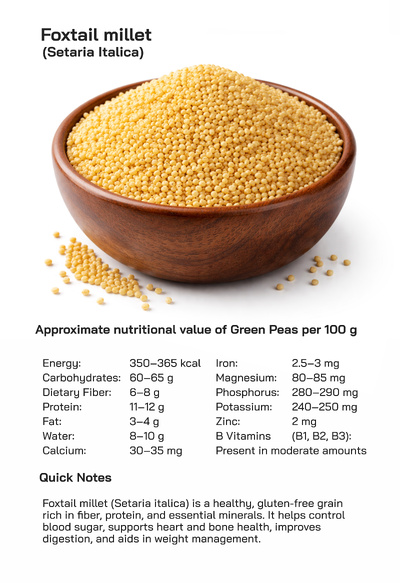
When bowls of cooked millet appear on tables, they carry stories of adaptation across centuries. They represent fields where rainfall may be uncertain yet hope persists. By continuing to cultivate and consume foxtail millet, societies reaffirm the value of crops that thrive in harmony with their environments while nourishing those who depend on them.
Each serving therefore represents more than nourishment. It signals commitment to diversity, respect for ecological realities, and recognition that resilience arises from cooperation between generations. Through steady adaptation, foxtail millet continues to contribute meaningfully to global food systems, reminding us that enduring strength often resides in the smallest seeds.